Birds of the World Brings Massive Birding Database to Everyone…Right?
Birding Databases: Who They Serve and Who They Forget
The past few years have been an interesting time in the birding community. While the pandemic created boom-like conditions for many retailers of birding supplies (supply-chain issues aside), existing birders encountered new frustrations in the forms of group event and travel cancellations and overcrowding of local birding sites.
Birding databases, like Cornell Lab’s Birds of the World (BOW), mirrored the blessings and hazards of the pandemic boom. BOW draws, in part, from the data collected on the citizen scientist platform eBird, which, according to Sara Harrison at Wired, experienced a 40 percent boost in sightings from 2019 to 2020 and a 50 percent increase in user logins. More users also entered more data, and while this data boost is not necessarily a bad thing, it brought about at least one new challenge for scientists, who “can’t always tell whether changes in the data are due to animal behavior or just an increase in the amount of information available.”
Embarrassments of data riches aside, there is clear value in platforms like BOW for supporting the birding community, especially during times of social distancing. That said, while it’s easy to imagine that birding is open to everyone given its low cost of entry and participants’ ability to do it anywhere, there are some critical considerations around who is able to access resources like BOW—and who is welcome in the birding community in the first place.
But First…What is Birds of the World and What Does it Offer?
BOW’s stated purpose is to provide “a single platform where biologists and birders can explore comprehensive life history information on birds,” drawing on source material from acclaimed encyclopedias, bird indexes, and citizen scientist platforms like eBird. Its community of users can expand their identification skills and knowledge of birds in new regions or just learn more about their local avian neighbours using BOW’s knowledge-building resources, which include photos, vocal recordings, videos, range maps, detailed textual descriptions, and more.
Proficient birders and ornithologists may submit text information directly to BOW for publishing (upon review), and all birders may submit media for potential use on the BOW site via eBird. Christoph Randler et al. spotlight how this contribution opportunity is particularly interesting for community knowledge growth as “some birdwatchers may be as equal in their skill and competence or even outperform formally trained scientists.” Randler adds, “the contribution of amateur taxonomists in ornithology is well-known.”
Access Requirements
Despite incorporating data leveraged from citizen scientists, the bulk of the BOW database is not, in fact, open to all, and the platform is best experienced with full subscription access. To be sure, many users can gain full access for free from a variety of local institutions (for example, I’m able to access the database with my free Calgary Public Library card). However, users unable to secure access via a local institution must pay $7.99/month (or $49/year).
Additional considerations include those around language proficiency and education levels. While birding has been linked to positive mental health outcomes for adults and children alike, and while, as White et al. suggest in a 2018 study, “action-based experiential learning” activities like birding “can increase children’s awareness, knowledge and attitudes towards local biodiversity,” resources like BOW put up high barriers to entry when it comes to language qualifications. Three different online readability tests (1, 2, 3) of the text content for the Corvid family (subscriber access required) suggest a high reading level is required to readily process bird descriptions.
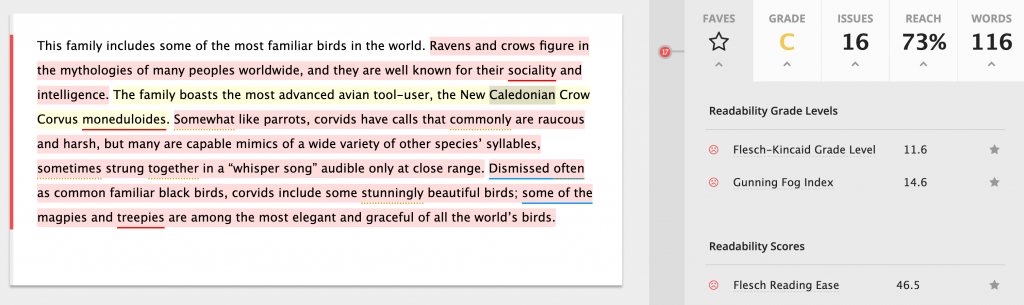
Further, not all readers may be comfortable with the formal science-heavy information, and knowledge of animal kingdom taxonomies is almost mandatory for easy navigation. Given that search results and navigation labels use the scientific Latin or Greek names, it’s understandable that many users may struggle to find their way around.
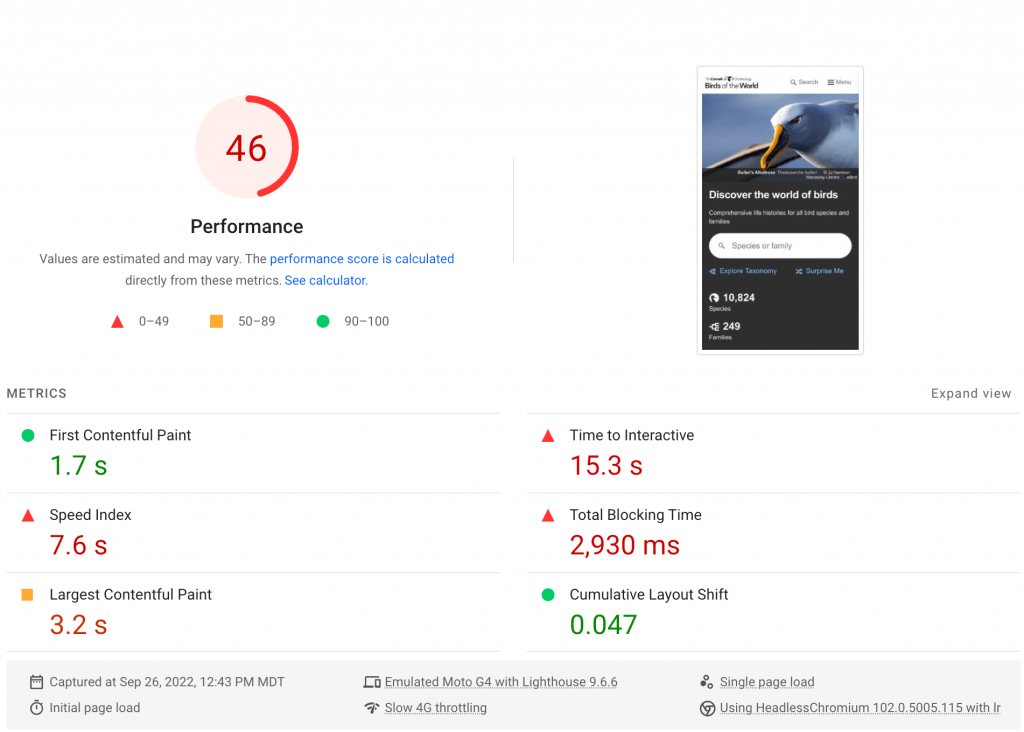
It’s also important to point out two primary technology requirements: stable internet access and a device capable of displaying the database’s contents. Interestingly, the mobile performance of BOW scores below average, meaning that users with older devices or weak connections may not be able to fully enjoy the site, subscriber access or not.
Deeper Demographic Considerations
In addition to education and technical issues, the community the BOW platform serves is also not entirely inclusive. In a 2021 study, Christoph Randler noted that men tend to contribute to citizen science platforms more than women, and higher-end birding materials (ex, cameras, lenses) can create pricing barriers to full participation.
More concerning, however, is birding’s legacy of racism. As a Washington Post article by Darryl Fears highlights, many common bird names have racist origins: “As with the wider field of conservation, racism and colonialism are in ornithology’s DNA, indelibly linked to its origin story.” Mostly white ornithologists are now engaged in a debate as to the value in changing “as many as 150 eponyms, names of birds that honor people with connections to slavery and supremacy.” Further, non-white birders often feel obligated “to appear as least threatening as possible” when exploring typical birding terrain, revealing deep inequity of access to enjoyment of the hobby despite the fact that natural and public areas should be equally open to all members of that very public.
Looking Beyond the Pandemic
It will be interesting to see whether the calls for diversification in the field grow louder in the wake of birding’s pandemic boom. As things stand, nothing on BOW suggests it’s moving toward allaying these concerns, instead using sterile, technical language to position itself as neutral and objective. Given this, we as users should access these resources keeping in mind that—while seemingly for everyone—they come with their own boundaries and assumptions.
Alternatively, we can start to dream of answers to what is perhaps a more engaging question: What might a non-colonial birding database look like? And if there’s such a database already in existence, please let me know so I can share more about it in this space.